


Cable Machine Exercises for Strength: The Full Guide
Key Takeaways
- Effective cable machine exercises for strength include lat pulldowns, seated rows, chest presses, face pulls, pushdowns, pull-throughs, and more.
- Train each one for 3 to 4 sets of 8 to 15 reps.
- Set the pulley height first, then pick the weight.
- Add weight once you hit the top of the rep range on every set.
- Cables complement heavy barbell lifts, including squats, deadlifts, and bench presses.
- Two to three cable machine workouts a week works well for most lifters.
Cable machine exercises keep tension on the muscle throughout an entire rep and let you train from any angle. This guide covers what to do, how to set it up, and how to build a weekly plan.

How Cable Exercises Build Strength
With dumbbells, gravity determines how much resistance you feel at different points in an exercise. In a curl or fly, some parts of the movement will feel harder than others. A cable provides resistance along the line of the pulley, allowing you to maintain tension through more of the range of motion.
Cable machines also offer other advantages for strength training. They let you train from different angles, work one side at a time, and adjust resistance in small increments.
- Work Out From Any Angle: Move the pulley, and you change the line of pull. That means you can adjust the pulley height and position to perform pulldowns, rows, presses, curls, and rotational exercises on one machine.
- Exercise One Side at a Time: Single-arm and single-leg cable exercises show you which side is lagging and let you fix it.
- Easy to Load: Moving a pin takes seconds. That makes drop sets and small weight jumps practical, and you never need a spotter.
- Friendly to Joints: Smooth, guided resistance is easier on shoulders and elbows than swinging a heavy dumbbell for many lifters.
Cable machine exercises will not replace a heavy squat, deadlift, or bench press when the goal is maximal strength. Pair a cable machine with a power rack and a barbell, and you have a complete home gym.

Set Up the Machine Before You Lift
Pulley height sets the line of pull, and the line of pull decides which muscles work. Set it too high or too low and the load drifts off the muscle you meant to train.
Match the height to the exercise using the chart below, then pick your weight.
| Pulley height | Use it for | Exercises |
| High (above head) | Pulling down toward the body | Lat pulldown, straight-arm pulldown, triceps pushdown, kneeling cable crunch |
| Mid (chest to face height) | Horizontal pulls, presses, and anti-rotation | Seated row, chest press, face pull, Pallof press |
| Low (floor to knee) | Pulling up, hinging, and hip extension | Curl, pull-through, glute kickback, lateral raise |
Step far enough from the stack that the cable has tension before you start the rep. Stand tall, brace your core, and choose a weight where the last two reps are hard but your form holds. If the weight stack bounces or your torso swings, the load is too heavy.
Best Cable Machine Exercises by Muscle Group
These are the best cable exercises to build a strength training program around. You can do all of them on a standard functional trainer with a few common cable machine attachments.

Back
Pulldowns and rows keep tension on the lats and mid-back, and both are easy to load heavier over time.
Lat Pulldown
High pulley · Wide bar · 3 to 4 sets of 8 to 12
Pull your elbows down toward your ribs instead of dragging the bar to your chin. Keep your chest tall and resist leaning back to finish reps. A multi-grip or pro-duty lat pulldown bar lets you change hand position without changing the machine.
Seated Cable Row
Mid or low pulley · V-handle · 3 sets of 10 to 12
Sit tall, pull the handle to your lower ribs, and squeeze your shoulder blades together for a one-second pause. A V-shaped or triangle grip keeps your elbows close, which loads the mid-back.
Straight-Arm Pulldown
High pulley · Rope or straight bar · 3 sets of 12 to 15
Keep your arms nearly straight and sweep the handle down to your thighs. It isolates the lats without the biceps taking over, which makes it a good finisher after rows and pulldowns.
Chest
Cables keep the chest loaded through the whole press and fly, including the squeeze at the end. Two handles mean each side works independently.
Cable Chest Press
Mid pulley · D-handles · 3 sets of 10 to 12
Use a staggered stance and press both handles forward until your hands meet. Because each arm works on its own cable, your stronger side cannot cover for the weaker one.
Cable Fly
High or low pulley · D-handles · 3 sets of 12 to 15
Keep a slight bend in your elbows and bring your hands together in an arc. Tension stays on the chest at the squeeze, which is the spot where a dumbbell fly goes slack. Set the pulleys low and fly up to target the upper chest.
Shoulders
Cables handle the small shoulder muscles well, since the pull stays smooth at angles dumbbells reach awkwardly. These two cover the rear and side delts.
Face Pull
Mid pulley at face height · Rope · 3 sets of 15
Pull the rope toward your forehead with your elbows high, then rotate your hands back and apart. It builds the rear delts and upper back, and it is one of the best cable exercises for balancing out a lot of pressing.
Cable Lateral Raise
Low pulley · Single handle · 3 sets of 12 to 15 per side
Stand sideways to the stack and raise the handle across your body to shoulder height. The cable keeps the side delt loaded at the bottom of the rep, whereas dumbbell raises offer no resistance.
Arms
Cables give arms smooth, steady resistance. One move each for triceps and biceps is enough, and both progress easily in small steps.
Triceps Rope Pushdown
High pulley · Rope · 3 sets of 10 to 15
Pin your elbows to your sides and spread the rope at the bottom. A tricep rope pulldown attachment is the one piece most people buy first.
Cable Curl
Low pulley · Straight bar or D-handle · 3 sets of 10 to 12
Keep your elbows still and curl without swinging. Unlike a dumbbell curl, a cable curl maintains tension on the biceps at the top of the rep.
Legs and Glutes
You can train the lower body on a cable machine without a loaded barbell on your back. These exercises target the glutes and hamstrings and pair well with squats and deadlifts.
Cable Pull-Through
Low pulley · Rope between the legs · 3 to 4 sets of 10 to 12
Face away from the stack, hinge at the hips, and drive them forward to stand. It trains the same hip hinge as a deadlift for glutes and hamstrings with far less load on your lower back.
Cable Glute Kickback
Low pulley · Ankle strap · 3 sets of 12 per leg
Hold the frame, keep your torso still, and kick straight back until your glute is fully squeezed. Go lighter than you expect and keep the movement slow.
Core
Cables train the core to resist movement as well as create it. These exercises cover anti-rotation, rotation, and flexion.
Pallof Press
Mid pulley · Single handle · 3 sets of 10 per side
Stand sideways to the stack, press the handle straight out, and hold for two seconds without letting your torso rotate. It is the best way to train your core to resist twisting.
Cable Woodchop
High pulley · Single handle · 3 sets of 10 per side
Pull the handle diagonally from high to low, turning your hips and shoulders together. Control the return as carefully as the pull.
Kneeling Cable Crunch
High pulley · Rope · 3 sets of 12 to 15
Kneel facing the stack, hold the rope at your head, and curl your ribs toward your hips. Add weight over time, just as you would for any other lift.
Shop Cable Machines



Three Cable Machine Workouts to Start With
You can run these cable machine workouts on their own or add them to your barbell days. Rest 90 seconds on rows and pulldowns and 45 to 60 seconds on the smaller movements.
A: Upper Body
About 45 minutes
- Lat pulldown 4 x 8-12
- Seated cable row 3 x 10-12
- Cable chest press 3 x 10-12
- Face pull 3 x 15
- Triceps pushdown 3 x 12
- Cable curl 3 x 12
B: Lower Body and Core
About 35 minutes
- Cable pull-through 4 x 10-12
- Glute kickback 3 x 12 / leg
- Pallof press 3 x 10 / side
- Cable woodchop 3 x 10 / side
- Kneeling crunch 3 x 12-15
C: Full Body, 30 Minutes
Two supersets and a finisher. Alternate 1a and 1b, rest 60 to 90 seconds, then repeat.
- Lat pulldown 3 x 10
- Cable chest press 3 x 10
- Pull-through 3 x 12
- Face pull 3 x 15
- Pallof press 2 x 10 / side
Doing two or three sessions a week is plenty for most lifters. Workouts A and B together cover your whole body, so if you only have two free days, do one each day. If you work out on a third day, alternate them so neither side of the plan falls behind: A, B, A one week, then B, A, B the next.
On a week when time is tight, swap Workout C in for the third session.

Choosing a Cable Machine for Your Home Gym
You can do everything above on a few different setups. The right one depends on your space and how many cable machine exercises you want to run.
Functional Trainer
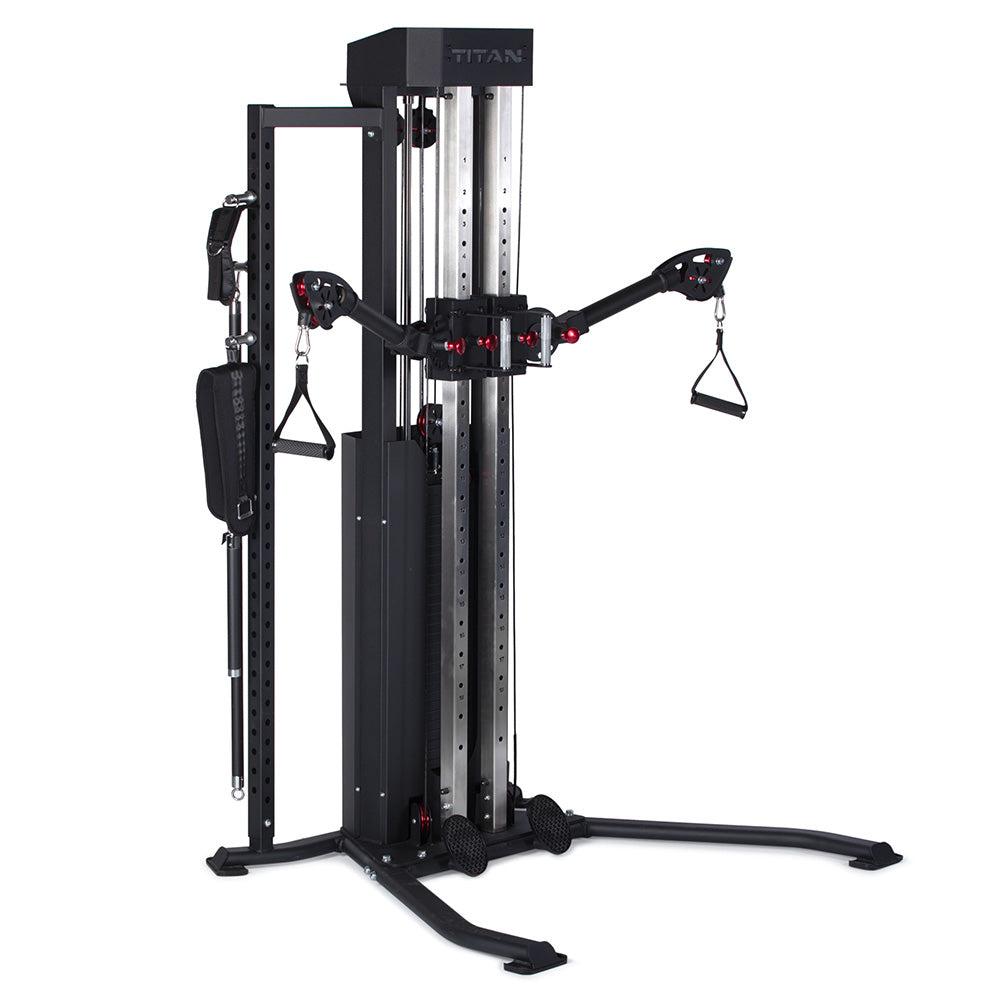
A functional trainer puts adjustable pulleys on a track, so one machine covers every exercise in this guide, from pulldowns to woodchops. It is the right pick if you have a dedicated space and want variety. It also takes more floor space than a single-purpose tower, so measure the room first.
Nemesis 300 LB Single Stack Functional Trainer
Check out the Nemesis 300 LB Single Stack from TITAN Fitness, a single-stack option for smaller rooms.
Weight Stack Machines
A lat tower pulldown and cable row machine gives you two-in-one functionality and takes less room than a full trainer. A weight stack machine also means no plates to load, since you change the weight with a pin. The tradeoff is range. Its exercise selection is more specialized, focusing on pulldowns and rows rather than movements like cable flyes and woodchops.
Cable Attachments
You do not need every attachment right away. A rope, a V-handle, and a pair of D-handles cover almost every exercise on this page. Add a lat bar if pulldowns are a priority. All of them are available in our cable machine attachments collection.
Portable Cable Systems
Short on space? A portable system like ANCORE has the smallest footprint of the options here, with a carrying case and wall and rack mounts. Compare its resistance range with the loads you use on rows and pulldowns, since it will not match a full weight stack
Free shipping applies to all Titan Fitness orders, so you can add a functional trainer, cable attachments, and an adjustable bench to round out your press-and-fly setup in one cart.
Set Up Your Cable Station With Titan Fitness
Get a full cable setup at home without a commercial gym budget. Pick the machine that fits your space, add the attachments you will use, and run every workout in this guide. Free shipping on all orders.
Contact Our Team for HelpFrequently Asked Questions About Cable Machine Exercises
Are cable exercises good for building strength?
Yes. Cable exercises build strength and muscle when you train close to failure and add load over time. They work best alongside heavy compound lifts.
How often should I do cable machine workouts?
Two to three sessions a week works for most lifters. Leave at least a day between sessions that train the same muscles.
What is the best cable exercise for the back?
The lat pulldown and the seated cable row are great options. Together, they cover vertical and horizontal pulling, and both are easy to progress.
Should I use cables or free weights?
Use both. Free weights are better for the biggest lifts. Cables are better for steady tension, single-limb work, and isolation exercises at angles that dumbbells cannot reach.


